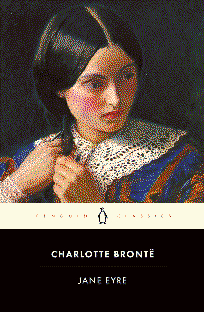
I was very excited to read Jane Eyre after enjoying Wuthering Heights so much. I was only a little bit intimidated by the pagecount (659) but
from the summary I knew I'd like it. And I did! I like Emily Brontë's style more, but I loved the story and especially the complexity of the characters.
I read that people find the pacing slow and especially the beginning, but I wasn't ever bored in the beginning, her childhood felt like a necessary buildup for what was to come.
Instead I started to get frustrated with the story over halfway. I wanted Mr. Rochester to come back, wanted to know what had become of him. I loved that Jane was still allowing us to hear about him through her thoughts,
but at some point I was worried he was going to be forgotten or dead. I loved her dynamic with St. John but thought too much time was spent on their relationship. I get that he's supposed to be the antithesis to Mr. Rochester,
but that only made me want him back more. And then when we finally got him back, it didn't last that long until the end... I thought that was really disappointing, I enjoyed the parts with Jane and Mr. Rochester the most of the whole story so
I would have so loved to have more of that. But alas.... a great love story though and one I enjoyed a lot.
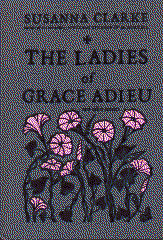
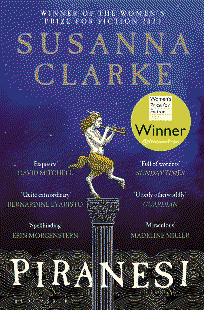
33. Piranesi by: Susanna Clarke
Finished: 14/12/2025
Rating: 5★ Review
It's been a while since I finished this, but I moved to a new appartment! Today is the first day where I feel like I have some room to breathe again. So, here is my review for Piranesi by Susanna Clarke. Oh and btw, do not read this review if you want to read the book. It contains spoilers and that will completely ruin the story..
Quickly rose to be one of my favourite books. I love piranesi, not just the book but the person as well. At first The House is dazzling and not always in a good way. Is it outside? inside? There's the sea everywhere, but also lot's of stairs, but also windows and courtyards (?). So it reads like a Greek inspired fantasy labyrinth. The person living there, Piranesi, he loves it. He adores The House, actually reveres it. But not in an annoying way, you almost grow to love The House as much as he does because he does it in such an honest, innocent and meaningful way.
The feeling that there is more to it than Piranesi knows creeps up pretty fast and it hooked me all the way until the end.
In many ways this book actually reminded me of I Who Have Never Known Men by Jacqueline Harpman (IWHNKM), but Piranesi gave me everything that I wanted from IWHNKM. It's about a man (Piranesi) who lives in a sort of labyrinth, which is basically just water, stairs, columns and statues. These stretch for kilometers as far as he knows. As far as we know, The Other (only other person he's ever seen) and Piranesi are the only ones there. His life is simple, it consists of sleeping, eating, exploring and journalling. In that way I thought it was very similar to IWHNKM which is also about someone 'trapped' in a non-earth world that is very repetitive and simple, without a clue as to where they are or why they are there, and simply trying to survive. Except wat Piranesi had that IWHNKM didn't is that the protagonist is full of wonder at his seemingly confusing, challenging and repetitive world.
We follow his journals just as we did in IWHNKM, but they're actually interesting to read. Piranesi has an inner world that he shares with us and it is written so realistically and relatable, through this sharing you really grow to love him and root for him. Unlike IWHNKM, the mystery unfolds itself and you actually find out what is going on, who Piranesi is and where he is and why, and it still gives me chills. The slow trickle of the mystery unfolding is done masterfully and makes this book unforgettable to me. The last sentence made me tear up. Oh and finding out Piranesi was an actual person who was known for his artwork of labyrinths of Roman architecture made the whole thing even more magical, it shows a real dedication of the author, everything ties together. It's a must read!
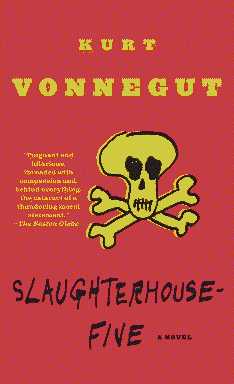
32. Slaughterhouse Five by: Kurt Vonnegut
Finished: 2/12/2025
Rating: Mild 3★ Review
Still not sure whether I loved this or was 'meh' about it. First of all I didn't realize it was semi-autobiographic. I also think that to me in 2025, it reads completely different than it probably did when it was first published in 1969, so I'm trying my best to process it from that perspective, but I think that's almost impossible for us in 2025. I've never experienced war and the fear of it still feels unreal to me (and I realize that I'm extremely privileged in this way) so I'm not sure if I'm the right audience for the book but who knows. It's an anti-war book in that it strips war completely of its supposed glory and there are only losers, and the story and the way it's written really confronts you with the stupidity of the whole thing.
It doesn't even directly criticize anything or anyone because it doesn't need to, it just gives you what happens point blank which is enough.
The time-jumps are sometimes confusing and disjointed but that must be on purpose. It helps that they are mostly the same set of memories, so after a while I got used to them and could pick up where they left off. I think it's sad that he only gets the jumps when he's sleeping, disoriented in the dark, or when people are trying to talk to him about it.
Vonnegut's style is a bit too staccato for me and I prefer a text that flows more, but it does fit his stories, this one even moreso than Cat's Cradle.
If I think really hard and try to imagine myself as a war prisoner, I think I might also go crazy. The only thing I thought was unrealistic was the Tralfamadorians at the zoo not being able to imagine what time would be like in three dimensions. As three dimensionals we can easily imagine what it's like to be in one dimensions or two, but not four. A four dimensional being should be able to imagine exactly what it's like to be in three dimensions. But it was a funny bit nonetheless and you could say there's nothing to be found realistic or unrealistic about time travel and aliens anyway.
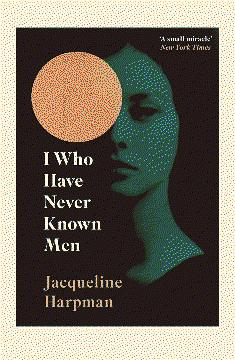
31. I Who Have Never Known Men by: Jacqueline Harpman
Finished: 14/11/2025
Rating: Bland 2★ Review
Based on the premise I really thought I was going to enjoy this more. I finished it in two days so I guess you could call it a page turner and I enjoyed some bits, but overall I was disappointed with the lack of explanations. The curiosity of what the women were going to find on their search for any sign of civilization kept me going but it wasn't satisfying.
It didn't help that I didn't find the narrator sympathetic or likeable. She felt too one-dimensional for me, even when taking her upbringing (or lack thereof) into account. I would have expected more a troubled mind or inner-conflict. If all you know is a cage, how can you be so resolved to get out? That and other things weren't believable for me, like the fact none of her cagemates ever gave her a name, or that the most important thing that's on her mind is that she doesn't know men or how to count time. I would be much more occupied with where I am and why instead of wondering what men are like I guess. Part of the reason that falls flat for me is that she dóes know men: all the guards are men. But later they find out there were also men imprisoned in the same way, so the whole gender approach stops making sense.
I was somewhat interested in the world itself once they get out, but you get no answers. Every solution I can think of creates problems elsewhere. The most logical explanation would be that it's an experiment for habitable planets, but then why would you imprison hunderds of people if you're trying to save the race? It feels like the easy way out to say you're meant to be as confused as the protagonist... It didn't feel like my views and beliefs of the world and of what it means to be alive were challenged enough by the book to excuse leaving so much unanswered. What I really loved about Hand Maid's Tale is that we get a sort of post-tale answers, I think that's what this book really needed. Because of the lack of explanations I'm not sure what the book is trying to say other than 'there is no real point to living'. But that's because nothing moves the protagonist, so I'm not moved as a reader, the group just goes through the motions and it becomes a bit redundant. I think I would have been more interested in some type of emotional conflict while they try to figure out how to survive, but instead it's mostly descriptions of the world, the food they find and the fabric their clothes are made of. I liked it a bit more towards the end, but not enough to recommend it.
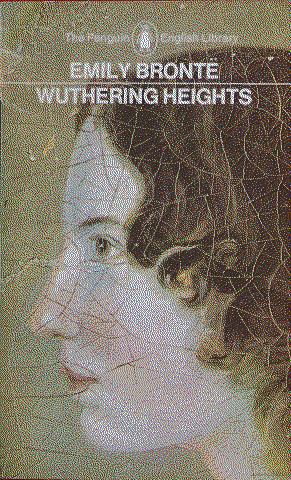
30. Wuthering Heights by: Emily Brontë
Finished: 12/11/2025
Rating: 5★ Review
If I had to describe this story in one word it would be tormented. I'm still reeling from this read, wow! My edition literally falls apart and I had to staple the pages together, so for my birthday next week I'm going to buy a collector's edition because I already want to reread it.
Probably one of my favourite stories of all time. I had to read the first 90 pages twice because: everyone has the same name, and is referred to differently depending on who is narrating which makes it an absolute nightmare to know what's going on. Combined with the old language I don't think it's beginner friendly, but it's so worth it. I felt like Charlie from Always Sunny while trying to construct the family tree.
Once I got the hang of the structure of the story and who was who, I was completely sucked in. Every page my mind was blown in a different way. The language is magic once you get into the flow of it, every sentence feels like it has a purpose and there are passages that I just had to read a couple of times because they were so beautiful. I can't think of a single thing I didn't like except maybe that, some scenes are described so compactly that they become vague, but the information is all there, you just have to dig it out of the words which is also fun once you start to recognize when that's necessary.
I agree that this isn't a romance, or even tragic because it's too violent and cruel for that. It's quite miserable and shocking. I think everyone has emotions or thoughts like these at some point in their lives which makes it cathartic in a way. I think it's bold and revolutionary (not just for its time but yet) for that reason.
Maliha_reads' review on storygraph is this and I think that's extremely fitting: "Wuthering Heights isn’t a love story, it’s a feral howl into the void. It grabs you by the collar, drags you across the moors, and leaves you breathless, bruised, and strangely grateful. This isn’t a cozy read. It’s a visceral experience. The moors are alive. The emotions are volcanic. The prose is poetic and piercing. Brontë doesn’t offer comfort, she offers catharsis."
I fully agree! If I have to put all the passages here that I love then it will be way too long, so I picked a popular one but with the first part included, which I don't understand is left out so often:
"May she wake in torment!" he cried, with frightful vehemence, stamping his foot, and groaning in a sudden paroxysm of ungovernable passion. "Why, she's a liar to the end! Where is she? Not there - not in heaven - not perished - where? Oh! You said you cared nothing for my sufferings. And I pray one prayer - I repeat it till my tongue stiffens - Catherine Earnshaw, may you not rest as long as I am living! You said I killed you - haunt me then! The murdered do haunt their murderers. I believe - I know that ghosts have wandered the earth. Be with me always - take any form - drive me mad! Only do not leave me in this abyss, where I cannot find you! Oh, God! It is unutterable! I cannot live without my life! I cannot live without my soul!"
Proceeds to destroy everything/everyone around him.. I think the book makes a really bold point of reaping what you sow. The healing only starts with Hareton and Catherine and it's all the way at the end, and I wish we had more of it. Fantastic story!
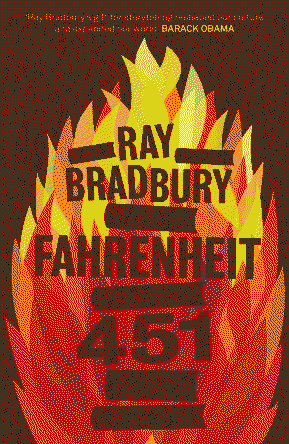
29. Fahrenheit 451 by: Ray Bradbury
Finished: 17/09/2025
Rating: Spicy 4★ Review
The last one for now in my dystopian books spree. The premise seemed really interesting to me and I really loved the story, even though it was quite simple and the writing not amazing, I really liked the fast pace.
Guy Montag's existential crisis about the world he lives in was very easy to relate to. He feels like either he must be crazy or everyone around him is and to be honest in the end you're still not really sure, he makes some really weird
and desperate decisions, but that makes him all the more likeable and realistic to me.
I really like how the author was able to capture his desperation. He is so flawed, but I don't dislike him for it, on the contrary it makes him more human and I was really rooting for him. I feel like not many would do better in his situation.
His wife is a husk of a person and he has to destroy people's houses and lives basically, it feels quite suffocating.
I would have liked Clarisse to have stayed a little longer, I thought it was really interesting how she was like a catalyst to Guy's 'awakening', but it felt like she was ripped away from the story too soon.
But then again, that was another one of the stepping stones for him to start reading, one day she was there, the next she was gone and no one cared.
And again I really like the type of antagonist that dystopian novels provide, Beatty in this case. A person that is 'in the know' but chooses to conform. Despite the fact that Beatty is the most well-read out of almost all the characters that we get to know in the book
he still does what he does, or more interestingly, maybe because of it. Mustapha Mond in Brave New World, The Benefactor in We, O'Brien in 1984 all have this in common somewhat. Someone that used to be like our protagonist (and like us to an extent) and that we relate to,
but even they are a part of the machine and even worse they enable it to exist. It really gives the feeling of hopelessness for our protagonist, as if it's saying 'see, I was you, it's easier if you just give in'.
One of my favourite parts about the book was probably Guy's wife Mildred. From the fact that they can't remember where or how they met and how little she cared about that, to the confusing 'family' she keeps talking about which is just TV programs personalized to say the viewer's name and her suicide attempt which she
completely forgot about the day after, and the part with her friends talking about nonsense and humouring Guy, those passages were just really fun and eratic. I definitely recommend the book though I do want to say that the pace is fast, the story is uncomplicated and the writing isn't perfect, but a very fun read.
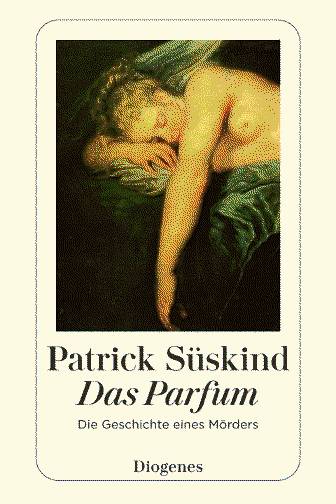
28. Das Parfum by: Patrick Süskind
Finished: 11/09/2025
Rating: Spicy 4★
ReviewI found a Dutch translation (Ronald Jonkers) of this book at a flea market and instantly knew it was going to be my next read. I'd seen the movie years ago when I was a teenager and loved it back then. The book turned out different than the movie I remember,
so this was also a classic case of trying to let go of what I thought the story was going to be like...
I had to get used to the writing style, some sentences are half a page long (typical for german I think).
But I got used to it pretty fast and not only the story but the writing and the words used,
and the construction of the sentences was poetic and absurd in itself.
In many cases I could not have found a more perfect word to describe a thing, emotion or scent the way Süskind did,
and it's probably even better in the original language. It's funny, the story is centered around scent, but the writing also plays on
your senses as a reader. Everything is described in such vibrant detail that you can see, hear or smell it,
it makes the book an experience and I definitely recommend it. But because of the long sentences I don't think it's an easy read,
though I don't know how it was translated in English of course.
As for Grenouille, I absolutely disliked him which I think you are
supposed to, but I could not find a single thing to like about him. All around a really uncomfortable character. The middle part was frustrating. I could understand his
need to get away from humans, but I didn't understand why that meant living in a cave for 7 years.
And why it took him 7 years to discover that he didn't have a scent. I think I realized too late that the story is meant to be absurdist,
but I blame the movie for that because it has a very different approach.
Strangely the end wasn't as satisfying as I'd hoped it would be..
I would have preferred him to have been ripped apart by the civilians on his 'day of judgement'.
That would have been a real fitting irony for me. I'm still not sure why the author didn't go for that. Maybe it's on purpose,
but this ending just didn't give me the satisfaction that I think the story deserved.
But overall it was a wonderful absurd journey and I highly recommend to give it a read.
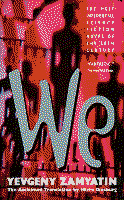
27. We by: Yevgeny Zamyatin
Finished: 24/08/2025
Rating: 5★
Review
Yesterday I finished reading 'We' written by Russian author Yevgeny Zamyatin, translated by Mirra Ginsburg. This will be my first time writing a 'serious' book review.
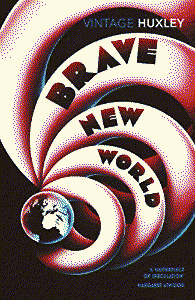
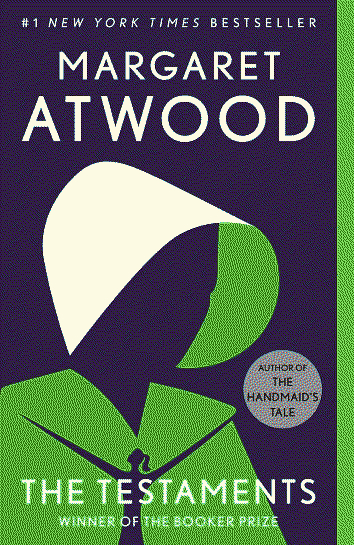
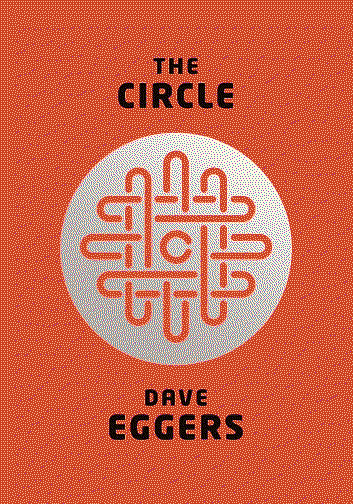
I was on a dystopian reading spree, so in the last couple of months I finished reading '1984' (G. Orwell), 'Cat's Cradle' (K. Vonnegut), 'Brave New World' (A. Huxley), 'The Power' (N. Alderman), 'The Circle' (D. Eggers) and 'The Handmaid's Tale' and 'The Testaments' (M. Atwood).
Right from the get go it's clear that the stories and settings in 1984 and Brave New World were inspired by 'We' and its One State (Big Brother and Mustapha Mond by the great Benefactor).
D-503 even reminds me of Winston, in his awakening, and I-330 of Julia. Where '1984' has telescreens, mics and the Thought Police, 'We' simply has buildings made of see-through glass - basicaly making any sort of surveillence unnecessary and by default - and ultimately the great operation.
Wow, just wow. Zamyatin's writing style is one thing I fell in love with. The writing style just completely drew me into the mind of D-503. I felt what he felt (or didn't feel). His monologues were especially interesting to me. The author has a talent for making absurd concepts sound completely logical which I really loved, usually in contrast to what we are used to in the modern world.
One of my favourite passages happens when D-503 looks through the glass wall that separates the One State from the outside world:
But fortunately between me and the wild green ocean was the glass of the Wall. Oh, great, divinely bounding wisdom of walls and barriers! They are, perhaps, the greatest of man's inventions. Man ceased to be a wild animal only when he built the first wall. Man ceased to be a savage only when we had
built the Green Wall, when we had isolated our perfect mechanical world from the irrational, hideous world of trees, birds, animals...
Through the glass the blunt snout of some beast stared dully, mistily at me; yellow eyes, persistently repeating a single, incomprehensible thought. For a long time we stared into each other's eyes - those mine-wells from the surface world into another, subterranean one. And a question stirred within me: What if he, this yellow-eyed creature in his disorderly, filthy mound of leaves, in his uncomputed life, is happier than we are?
I raised my hand, the yellow eyes blinked, backed away, and disappeared among the greenery. The paltry creature! What absurdity - that he could possibly be happier than we are! Happier than I, perhaps; but I am only an exception, I am sick.
What I love about this passage is first of all the observation that we make through D-503. While reading we are looking with him through the glass wall at all of the life behind it which in his eyes is irrational and hideous. From their glass, straight-lined One State, you might even agree with him that it ís irrational and hideous.
But what he sees there (I'm guessing a boar) isn't charging at him or doing something mindless, it's seeing him just as much as he sees it. We don't know if the boar is repeating a single, incomprehensible thought...or it wouldn't stop in its tracks to lock eyes with D-503. That's why I find his next thought so fitting, the silence and attention of the moment is making him doubt
whether he might not be the thing he is describing, maybe he is the one that is trapped and unhappy, is he simply projecting this onto the boar. He even waves at it (what else could he be raising his hand for?). Obviously a boar doesn't know what that is and the connection is broken, which also breaks
his train of thought that the boar might be better off. It shows the amount of conditioning that citizens of One State have gone through, to think otherwise than that they have found the ultimate happiness is absurd.
The funniest thing is then that he has already embraced the idea that he is sick for having fallen in love and dreaming (all symptoms of having a 'soul'), and that the boar might actually bé happier than him as an individual for this reason. Even though I think the opposite is true: he is probably happier than his neighbours exactly because of his awakening.
Aren't his complicated feelings and emotions exactly what should set him apart from a boar? This is just one of the examples which shows exactly what I love about Zamyatin's writing style, he is able to put a lot of information
into a very short and dense piece of writing if that makes sense. This short piece already tells us so much about D-503 and the world he lives in, and the beliefs he has. It is pure 'show don't tell'.
The story can get a little confusing at times. It switches fast between situations and places, and sometimes I found it hard to follow who was speaking. But at the same time
this helped to crawl into D-503's skin. And I think it could be the result of things getting lost in translation, which is why I want to read one of the newer translations at some point. I'm curious if the same 'idiosyncrasies' of the writing are kept,
such as the fact that characters often don't finish their sentences, especially when they are emotional. Which I just think is such a beautiful, realistic and relatable detail, another thing I really enjoyed reading, it made the characters feel alive.
This review is already quite long so I think I'll leave it at this. I recommend this book to anyone who enjoys dystopias and especially '1984' and 'Brave New World'. It's genuinely witty, funny, intelligent writing and the story is a classic, but I mean it was written in 1920 and revolutionary for its time.
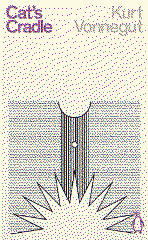
26. Cat's Cradle by: Kurt Vonnegut
Finished: 15/07/2025
Rating: Bland 4★
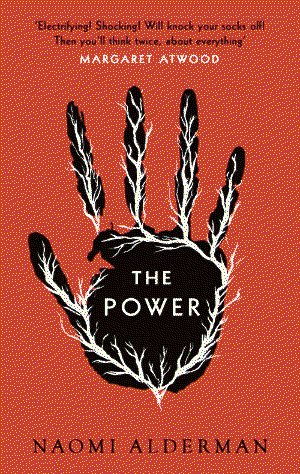
25. The Power by: Naomi Alderman
Finished: 13/06/2025
Rating: 1★
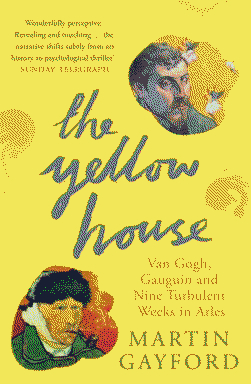
24. The Yellow House by: Martin Gayford
Status: Paused
23. Brave New World by: Aldous Huxley
Finished: 30/05/2025
Rating: 5★
22. Komt een vrouw bij de dokter by: Kluun
Finished: 20/05/2025
Rating: Mild 3★
21. The Testaments by: Margaret Atwood
Finished: 03/05/2025
Rating: Spicy 4★
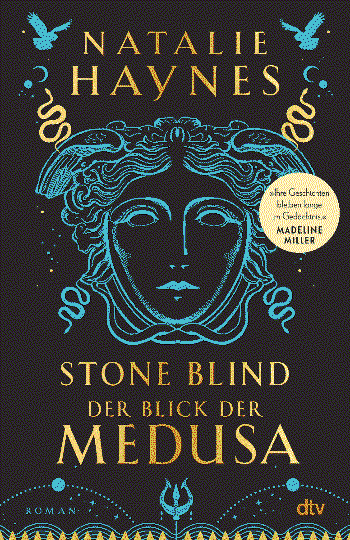
20. Stone Blind by: Natalie Haynes
Finished: 07/03/2025
Rating: Spicy 4★
19. The Circle by: Dave Eggers
Finished: 21/02/2025
Rating: Bland 2★
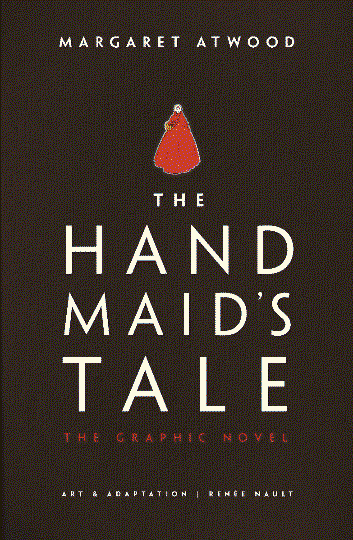
18. The Handmaid's Tale by: Margaret Atwood
Finished: 09/02/2025
Rating: 5★
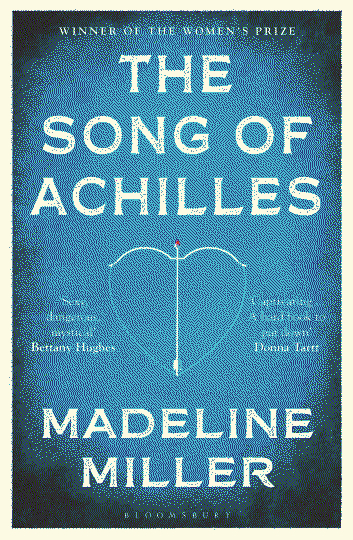
17. The Song of Achilles by: Madeline Miller
Finished: 31/01/2021
Rating: 5★
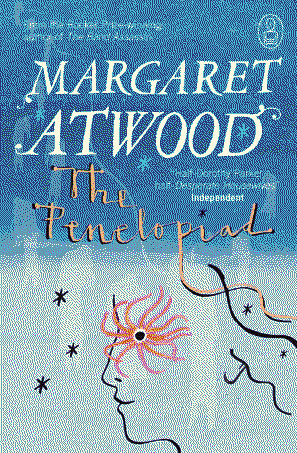
16. The Penelopiad by: Margaret Atwood
Finished: 24/01/2025
Rating: Spicy 4★
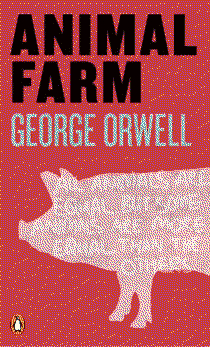
15. Animal Farm by: George Orwell
Finished: 15/01/2025
Rating: Mild 3★
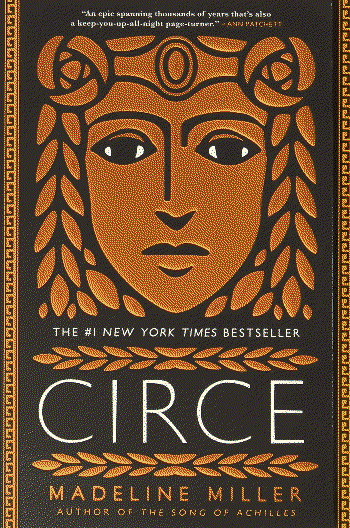
14. Circe by: Madeline Miller
Finished: 01/2025
Rating: 5★
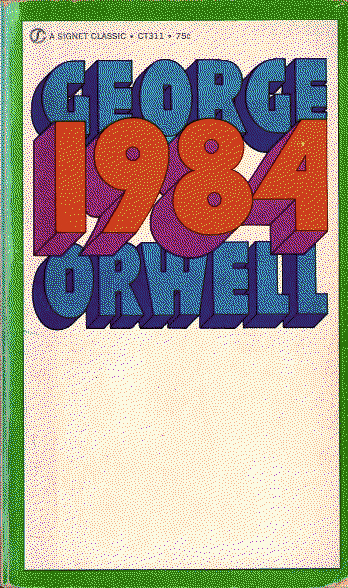
13. 1984 by: George Orwell
Finished: 01/2025
Rating: 5★
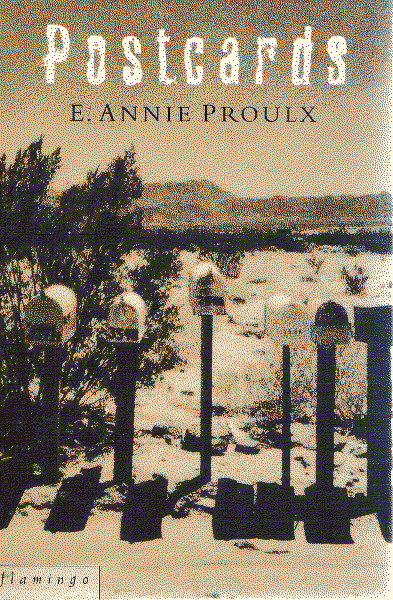
12. Postcards by: Annie Proulx
Finished: 25/12/2024
Rating: Spicy 4★
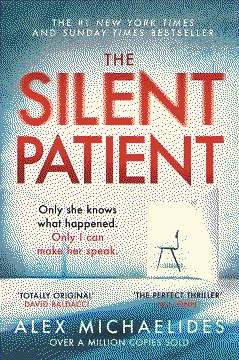
11. The Silent Patient by: Alex Michaelides
Finished: 11/2024
Rating: Spicy 4★
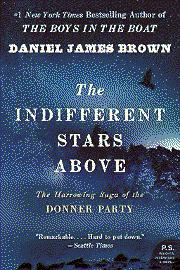
10. The Indifferent Stars Above by: Daniel James Brown
Finished: 08/2024
Rating: Spicy 4★
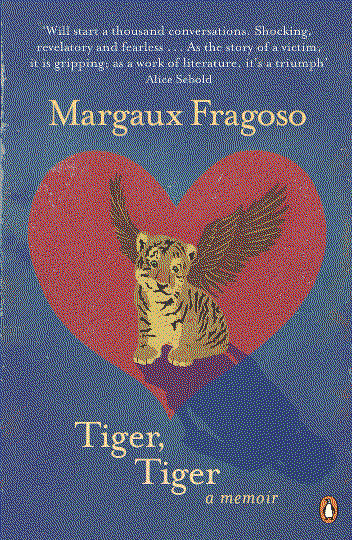
9. Tiger, Tiger: A Memoir by: Margaux Fragoso
Finished: 2024
Rating: Spicy 4★
8. Een blad in de wind by: Jacoba van Velde
Finished: 2024
Rating: Bland 4★
7. Mijn leven als Geisha by: Mineko Iwasaki
Finished: —
Rating: Spicy 4★
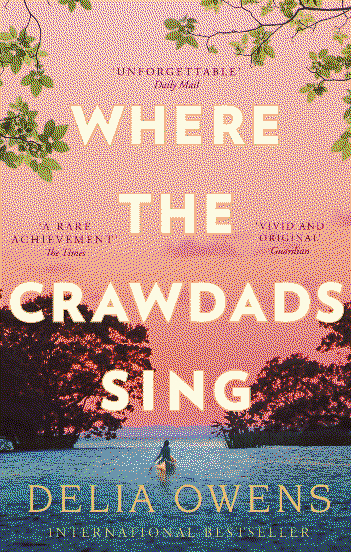
6. Where the Crawdads Sing by: Delia Owens
Finished: —
Rating: 5★
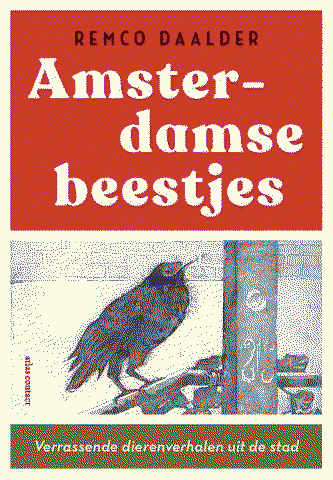
5. Stadse Beestjes by: Remco Daalder
Finished: —
Rating: Bland 3★
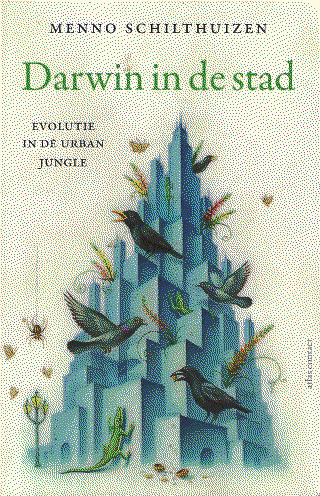
4. Darwin in de stad by: Menno Schilthuizen
Finished: —
Rating: Bland 4★
3. We hebben het over je gehad by: Stéphanie Hoogenberk
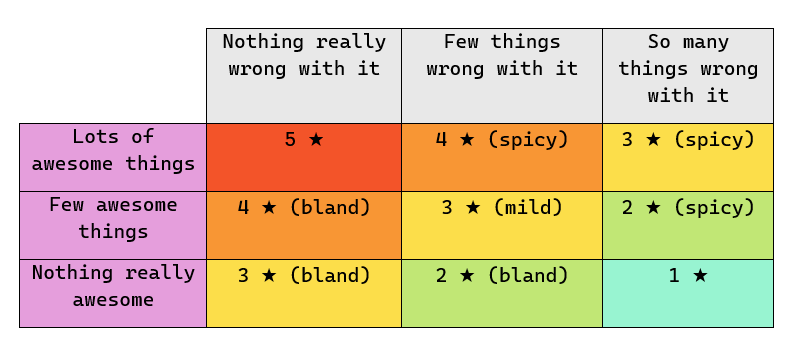
The idea is that you rate the thing on how much stuff you loved and how much stuff you hated, and those things weigh against each other. There's only one way to get 5 stars or 1 star, so those should end up as the rarest ratings, with 3 stars being the most common.
'Spicy' means that the thing inspires emotion, whether positive or negative, while 'bland' means it doesn't affect you much either way.
An example of a 3-star (spicy) - for me personally - would be the Twilight series, because there's plenty of garbage in there but also some things that are like crack to me. I can't think of an example of a 3 star (bland) because by nature they don't stick in the mind.

(This also assumes giving 0 stars isn't allowed. That'd throw it out of whack...) — aromanticduck